
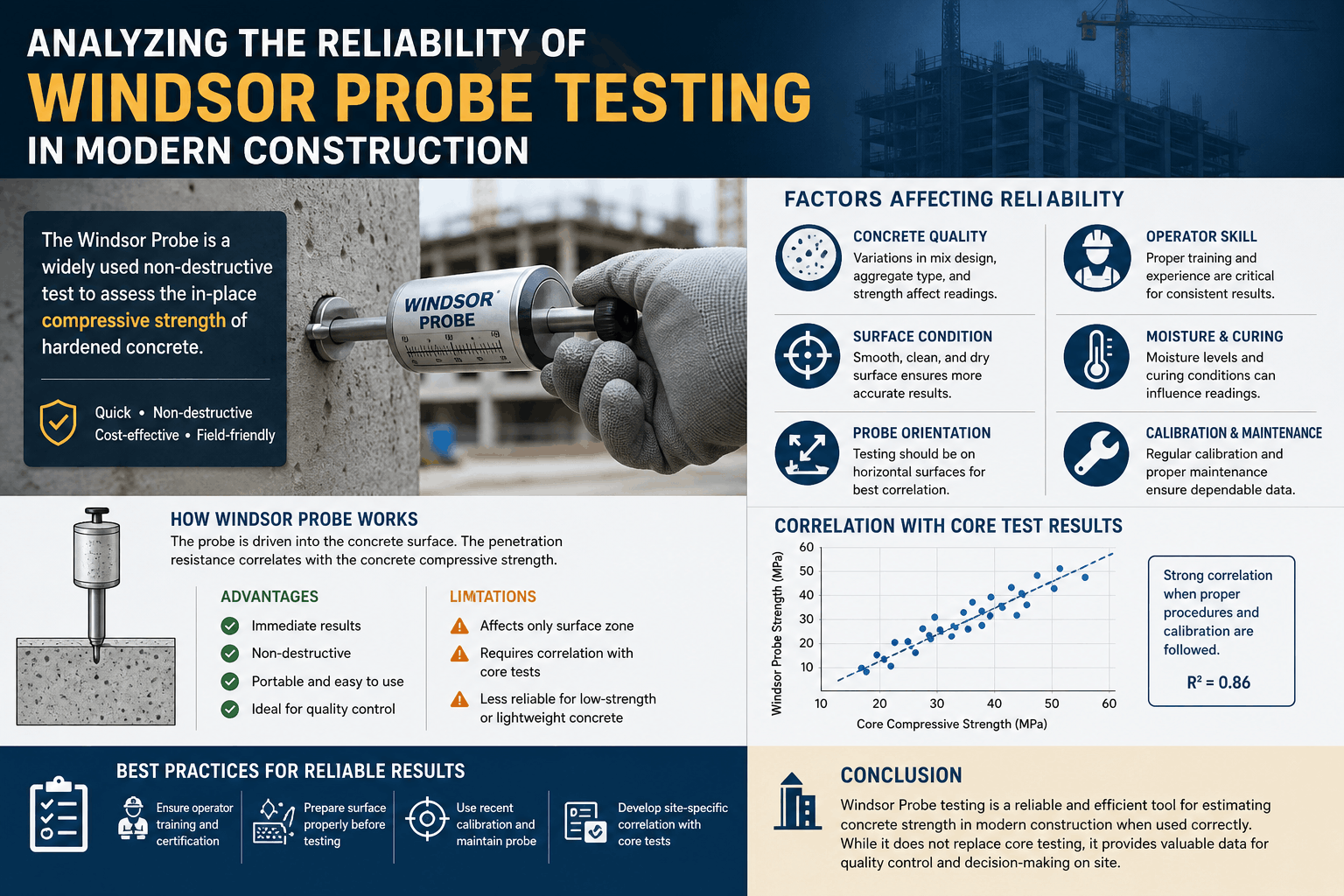

You cannot treat Windsor Probe numbers as absolute strength unless you have built the correlation yourself. That single mistake still shows up on sites, even on large projects with strict QA logs. The reliability of Windsor probe testing depends less on the tool and more on how disciplined the testing program is from day one.
Concrete strength is not a single variable. Mix proportions shift. Aggregate hardness shifts. Curing changes everything. And Windsor Probe responds to all of it.
The method itself is straightforward. A hardened alloy probe is driven into concrete using a calibrated powder charge. Penetration depth is measured. That depth is then related to compressive strength using a previously developed correlation curve. ASTM C803 governs the procedure. But that curve. That is where accuracy lives or collapses.
If you skip correlation, the reading reflects surface hardness. Not compressive strength.
And surface hardness lies.
Why does Correlation define Accuracy?
Generic charts exist. Many teams still use them. That introduces error, sometimes by wide margins.
Because two mixes with identical design strength can behave differently under probe impact. A mix with granite aggregate resists penetration more than one with limestone. Same compressive strength. Different readings.
So the reliability of Windsor probe testing increases only when you develop project-specific curves using paired core samples. That means extracting cores, testing them in compression, and matching those results with probe penetration values taken at the same locations.
Without that pairing, readings remain relative. Not absolute.
A project in Riyadh studied slab elements ranging from 5 MPa to 70 MPa. The correlation curves shifted noticeably between mixes. When generic curves were applied, deviations crossed acceptable tolerances. Once calibrated, the curves were used, results aligned closely with lab-tested strengths.
That difference decides whether a structure moves forward or gets delayed.
Performance Across Concrete Age
Early-age concrete behaves differently under probe impact. Less hydration. Lower internal cohesion. Penetration depth increases.
In the first 3 to 7 days, the reliability of Windsor probe testing often surpasses small core testing. Cores at that stage tend to disturb the material and introduce variability. The probe, in contrast, gives a quicker and more consistent index of hardness.
At 28 days and beyond, things shift.
Hydration stabilizes. Strength gain slows. Surface carbonation begins to influence readings. The probe starts reflecting a hardened outer layer that does not fully represent internal strength.
So late-age testing requires tighter calibration. Often with age-adjusted curves.
A bridge deck assessment in Texas highlighted this issue. Probe readings indicated higher strength than expected. Core tests later showed lower internal compressive strength. Carbonation had stiffened the surface layer, reducing probe penetration artificially.
That gap matters in structural evaluation.
Influence of Aggregate and Mix Design
Aggregate type drives resistance. Hard aggregates reduce penetration. Soft aggregates increase it.
So a single correlation curve cannot cover:
- Normal weight concrete
- Lightweight concrete
- High-performance concrete
Each requires its own calibration.
In one controlled lab study, lightweight concrete showed penetration depths up to 30 percent higher than normal weight mixes at the same compressive strength. Using a standard curve would have underestimated the strength significantly.
The reliability of Windsor probe testing depends on isolating these variables.
Water-cement ratio also plays a role. Lower ratios produce denser concrete, reducing penetration depth. Admixtures complicate the picture further. Silica fume mixes, for example, show different surface characteristics compared to standard mixes.
So every mix design demands attention.
No shortcuts.
Surface Condition Effects
Surface condition introduces one of the largest sources of error.
Finishing methods alter density at the top layer. Troweled surfaces often appear harder than the bulk material. Rough finishes behave differently.
Moisture content matters. Wet surfaces reduce resistance. Dry, carbonated surfaces increase it.
Carbonation alone can reduce penetration by 20 to 50 percent. That translates into overestimated strength if not corrected.
On a parking structure rehabilitation project, probe testing initially suggested adequate strength for overlay bonding. Later, bond failure occurred. Investigation revealed surface carbonation had skewed readings.
The issue was not the method. It was the interpretation.
Semi-Destructive Nature and Field Practicality
The Windsor Probe is not fully non-destructive. It leaves small holes. Minor surface blemishes. For architectural finishes, that becomes a limitation.
Still, compared to coring, the damage remains minimal.
That trade-off makes it attractive for in-situ assessments. Especially when multiple readings are required across a large surface.
The reliability of Windsor probe testing improves when multiple tests are averaged across a grid. Single readings should never drive decisions.
A grid-based approach reduces localized variability and highlights patterns. Weak zones become visible. Uniformity can be assessed quickly.
Speed remains one of its strongest advantages.
Comparison with Core Testing
Core testing remains the reference method. Direct measurement of compressive strength. No interpretation layer.
But cores introduce their own issues:
- Time delay for lab results
- Structural impact due to extraction
- Higher cost per test
- Limited number of sampling points
Windsor Probe fills the gap between speed and coverage.
It does not replace cores. It complements them.
In early construction stages, probe testing helps determine safe timing for formwork removal. In later stages, it supports uniformity checks before selecting core locations.
So the reliability of Windsor probe testing improves when integrated into a broader testing strategy rather than used in isolation.
Compliance and Standards
ASTM C803 sets the procedure. ACI guidelines reinforce the need for correlation.
Skipping correlation leads to non-compliance. Yet it still happens in fast-track projects.
OSHA-related safety decisions, such as load application or formwork removal, demand accurate strength verification. Field-cured cylinders often serve that role. Windsor Probe can support those decisions, but only when properly calibrated.
Otherwise, it introduces risk.
Case Examples from Active Construction and Structural Assessment Projects
Field performance tells a clearer story than controlled data alone. These case examples present how Windsor Probe testing behaves under real site constraints, varying materials, and time pressure. Each scenario reflects measured outcomes, decisions taken, and how testing accuracy aligned with structural requirements.
Case Example #1: Early Strength Verification
A mid-rise commercial building required early stripping of formwork to maintain the schedule. Cylinder tests lagged behind site progress.
Windsor Probe testing was introduced. Correlation curves were developed using early cores.
Results showed consistent strength gain matching design expectations. Formwork removal proceeded safely. No delays.
In this scenario, the reliability of Windsor probe testing directly supported construction efficiency.
Case Example #2: Dispute Resolution
A contractor faced rejection due to low cylinder test results. Structural elements were already in place.
Probe testing across multiple locations showed higher in-place strength. Core tests confirmed the probe-based assessment.
The discrepancy arose from improper cylinder curing conditions.
Here, probe testing helped resolve a costly dispute.
Case Example #3: Existing Structure Assessment
An aging industrial slab required evaluation before installing heavy equipment.
Probe testing identified zones with lower surface resistance. Core sampling focused on those areas.
Results confirmed localized deterioration.
Instead of replacing the entire slab, repairs targeted specific zones. That reduced cost and downtime.
The reliability of Windsor probe testing in this case depended on its use as a screening tool.
High-Strength Concrete Applications
Modern projects use high-performance concrete exceeding 100 MPa.
Windsor Probe systems have evolved to handle such strengths. Specialized probes and charges are required.
Studies show a strong correlation up to 17,000 psi when calibrated properly.
But sensitivity increases. Small variations in penetration depth correspond to large changes in strength.
So precision in measurement becomes critical.
Again, correlation defines success.
Limitations that Cannot be Ignored
It does not measure compressive strength directly.
It reflects resistance to penetration.
That distinction matters.
Other limitations:
- Not suitable for thin elements
- Affected by reinforcement proximity
- Sensitive to operator consistency
- Requires trained personnel
Misuse remains the biggest issue.
Teams often seek quick answers. They skip calibration. They rely on charts. They report strength values that appear precise but lack foundation.
That leads to false confidence.
The reliability of Windsor probe testing drops sharply under such conditions.
Economic Considerations
At first glance, probe testing appears cost-effective. Rapid results. Minimal equipment.
But correlation requires additional testing. Core extraction. Lab analysis.
That increases cost.
Still, when used strategically, overall savings emerge. Reduced delays. Fewer cores. Better targeting of investigations.
Cost depends on planning.
Best Practices for Reliable Results
- Develop project-specific correlation curves
- Use paired core tests across strength ranges
- Account for the mix design and aggregate type
- Perform multiple readings per test location
- Avoid testing near edges or reinforcement
- Record surface conditions and moisture levels
- Recalibrate for different ages if required
Follow these steps, and the reliability of Windsor probe testing improves significantly.
Ignore them, and the method becomes unreliable.
Interpreting Results in Context
Numbers alone do not tell the full story.
A penetration depth reading must be viewed alongside:
- Concrete age
- Environmental exposure
- Curing history
- Surface condition
Engineers should treat probe results as part of a broader dataset.
Not as a standalone decision tool.
That mindset separates effective use from misuse.
Where Does It Fit in Modern Construction?
Fast-paced projects demand quick feedback. Waiting for lab results slows progress.
Windsor Probe offers immediate insight. That makes it valuable.
But only when paired with discipline.
Modern construction relies on layered testing strategies. No single method dominates.
Probe testing supports early decisions. Core testing confirms them. Other non-destructive methods fill gaps.
The reliability of windsor probe testing improves when it operates within this system.
Final Technical Perspective
It works. But not blindly.
Accuracy depends on correlation, calibration, and context.
Used correctly, it provides consistent, actionable data. Used incorrectly, it misleads.
That distinction defines its place in structural evaluation.
About Our Windsor Probe Testing Services
We approach every project with a structured calibration process. No assumptions. No generic charts. Our Windsor Probe testing in Reston, Virginia, follows strict ASTM procedures with project-specific correlation curves developed through paired core sampling. We assess mix design, aggregate type, and surface condition before testing begins. That ensures the reliability of Windsor probe testing remains consistent across all readings. Our team delivers fast, accurate in-place strength evaluation for new and existing structures. If you need dependable results without unnecessary delays, work with us at Concrete Insight LLC. Contact us today to schedule your testing program and get clear, defensible data for your project.
Comments