
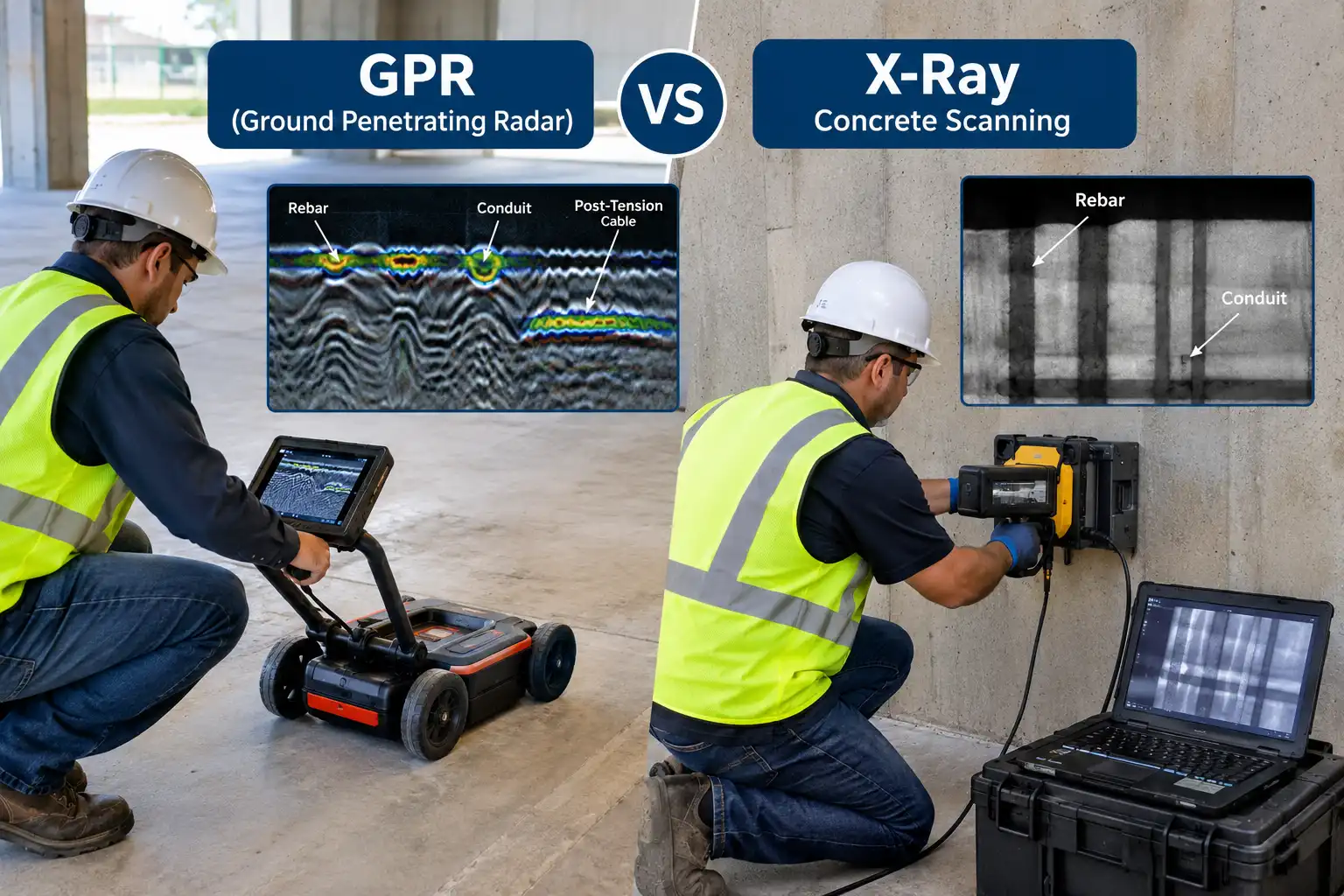

Concrete structures often contain much more than what is visible on the surface. Rebar, post-tension cables, electrical conduits, plumbing lines, voids, and other embedded elements can be hidden inside a slab or wall. Drilling, cutting, coring, or anchoring without knowing what is inside can lead to serious damage, project delays, and expensive repairs.
This is where concrete scanning becomes important. Two commonly used methods are Ground Penetrating Radar, also known as GPR, and X-ray concrete scanning.
Understanding GPR vs X-Ray concrete scanning can help contractors, engineers, property owners, and project managers choose the right inspection method for their specific needs. Both technologies can identify hidden features inside concrete, but they work differently and have different advantages.
What Is GPR Concrete Scanning?
Ground Penetrating Radar, or GPR, is a non-destructive scanning technology that uses electromagnetic waves to identify objects and changes beneath the surface of concrete.
A GPR scanner is moved across the concrete surface. The system sends radar signals into the material and records the signals that are reflected. Technicians can analyse these reflections to identify embedded objects and changes within the concrete.
GPR can help locate:
- Rebar
- Post-tension cables
- Electrical conduits
- PVC pipes
- Metal objects
- Voids and air pockets
- Changes in slab thickness
- Other subsurface features
One of the biggest advantages of GPR is that scanning can generally be performed without damaging the concrete.
What Is X-Ray Concrete Scanning?
X-ray concrete scanning uses X-ray radiation to create an image of the internal structure of concrete. Unlike GPR, X-ray scanning requires radiation equipment and generally needs access to both sides of the concrete element.
During an X-ray inspection, radiation passes through the concrete and creates an image that can show embedded materials such as rebar, conduits, and other objects.
Because X-ray equipment uses radiation, the area usually needs to be controlled during the inspection. This can make the process more involved, particularly on busy construction sites or occupied buildings.
GPR vs X-Ray Concrete Scanning: How Do They Work Differently?
The main difference in GPR vs X-Ray concrete scanning is the technology used to inspect the concrete.
GPR uses electromagnetic radar signals and analyses the reflections from materials beneath the surface. X-ray scanning uses radiation that passes through the concrete to create an image.
Here is a simple comparison:
| Factor | GPR Scanning | X-ray Scanning |
|---|---|---|
| Technology | Electromagnetic radar | X-ray radiation |
| Concrete damage | Non destructive | Non destructive |
| Access requirements | Generally one side | Usually requires access to both sides |
| Radiation | No | Yes |
| Site disruption | Usually low | Can require controlled areas |
| Scanning speed | Generally fast | Can take more preparation |
| Rebar detection | Yes | Yes |
| Utility detection | Yes | Yes |
| Voids and anomalies | Can identify | May identify depending on conditions |
| Safety requirements | Relatively simple | Requires radiation safety procedures |
The right option depends on the concrete structure, project requirements, access, site conditions, and information needed.
When Is GPR Scanning the Better Choice?
For many construction and concrete inspection projects, GPR offers a practical and efficient solution.
GPR can be particularly useful when only one side of the concrete is accessible. This is common when scanning floors, slabs, decks, walls, and other structures where reaching the opposite side may not be practical. GPR can also be useful when the work needs to be completed quickly without significantly disrupting construction activities.
1. Before Core Drilling
Before drilling a core hole, it is important to understand what is located inside the concrete. GPR can help identify rebar, PT cables, conduits, pipes, and other embedded features before drilling begins. This allows contractors to select safer drilling locations.
2. Before Concrete Cutting
Concrete cutting can expose workers and structures to unnecessary risks if hidden elements are not identified beforehand. GPR scanning can help create a clearer picture of what lies beneath the surface before saw cutting or other concrete modification work begins.
3. When Only One Side Is Accessible
One major advantage of GPR in the GPR vs X-Ray concrete scanning comparison is its flexibility when access is limited. A technician can scan a concrete slab or surface from one side without needing access to the opposite side in many applications.
4. On Active Construction Sites
Construction projects often have tight schedules. GPR can generally be performed without the radiation exclusion zones associated with X-ray scanning. This can make GPR a convenient option for commercial buildings, parking garages, offices, hospitals, warehouses, and other active environments.
When Can X-Ray Scanning Be Useful?
X-ray scanning can provide highly detailed images of concrete under suitable conditions. It can be especially useful when a project requires an image that clearly shows the internal arrangement of reinforcement and other embedded elements. However, X-ray scanning comes with additional requirements.
I. Access to Both Sides
X-ray scanning generally requires access to both sides of the concrete element. This may be difficult with thick slabs, ground-supported structures, walls, or areas where the opposite side is inaccessible.
II. Radiation Safety
Because X-ray equipment produces radiation, safety procedures must be followed. The area may need to be restricted while the scan is being performed.
III. Site Planning
X-ray inspections can require additional preparation because of equipment positioning, radiation control, and access requirements. For some projects, these requirements make GPR a more convenient option.
GPR vs X-Ray Concrete Scanning for Rebar Detection
Both methods can be used to identify reinforcement inside concrete. Rebar location is important before drilling, anchoring, coring, cutting, or modifying a concrete structure.
GPR can help technicians identify the location and approximate depth of reinforcement while scanning the surface. This information can then be used to identify suitable areas for drilling or other work.
X-ray can also provide detailed images of reinforcement, but the inspection setup can be more complicated because of radiation safety and access requirements. Therefore, when considering GPR vs X-Ray concrete scanning, the better method depends on the project's specific requirements rather than simply choosing the technology that produces the most detailed image.
GPR vs X-Ray Concrete Scanning for PT Cables
Post-tensioned concrete requires particular care. PT cables are tensioned components that help provide structural strength to concrete slabs. Accidentally drilling or cutting a PT cable can create serious safety and structural concerns.
GPR can help locate PT cables before drilling, coring, cutting, or anchoring work begins. This makes pre-construction scanning an important step when working with post-tensioned structures. A technician can scan the proposed work area and identify potential cable locations so the project team can make better decisions about where work should be performed.
Which Method Is Faster?
Project conditions can affect scanning time, but GPR is often a convenient choice when the goal is to quickly inspect a concrete surface before construction work.
The equipment can be moved across the surface, and the data can be reviewed by a trained technician. X-ray scanning may require additional setup because the equipment must be positioned correctly and the area needs appropriate radiation controls. For projects with tight schedules, these differences can be important.
Which Method Is Safer?
Both methods can be used safely when performed by properly trained professionals. However, GPR does not use ionising radiation. This can make it particularly attractive for occupied buildings and active construction environments.
X-ray scanning requires radiation safety procedures and appropriate controls to protect workers and other people in the surrounding area. Safety should always be considered alongside the technical requirements of the project.
Is GPR Always Better Than X-Ray?
Not necessarily. The goal of GPR vs X-Ray concrete scanning should not be to identify one technology as universally better. Instead, the right method depends on what you need to inspect and the conditions at the site.
GPR may be preferable when:
- Only one side of the concrete is accessible
- The project requires quick scanning
- Radiation is undesirable
- The area is occupied
- Contractors need to locate utilities before drilling
- The project involves large surface areas
X-ray may be considered when:
- Both sides of the concrete are accessible
- Detailed radiographic imaging is required
- Site conditions are suitable for radiation controls
- The project specifically calls for X-ray inspection
An experienced concrete scanning professional can evaluate the project and recommend the appropriate method.
What Should You Consider Before Choosing a Scanning Method?
When comparing GPR vs X-ray concrete scanning, consider these factors before making a decision:
- Project Type: Are you drilling, coring, cutting, anchoring, or modifying an existing structure? The type of work can influence the inspection method.
- Concrete Thickness: The thickness and composition of the concrete can affect how effectively a scanning method performs.
- Accessibility: Determine whether technicians can access one side or both sides of the concrete.
- Site Conditions: Busy construction sites, occupied buildings, hospitals, offices, and other sensitive environments may have different requirements.
- Information Required: Think about what you need to identify. You may need to locate rebar, PT cables, conduits, pipes, voids, or other subsurface features.
- Project Schedule: If construction work needs to begin quickly, the speed and setup requirements of the scanning method should be considered.
Why Professional Concrete Scanning Matters
Choosing the right technology is only one part of the process. The quality of the inspection also depends on the equipment, technician experience, site conditions, and interpretation of the collected data.
Professional technicians know how to identify radar patterns and interpret the information collected during scanning. They can help distinguish between different subsurface features and provide useful information to contractors and engineers.
A professional inspection before drilling or cutting can help reduce the risk of damaging embedded utilities and structural components. It can also help contractors make better decisions before work begins.
Choose the Right Scanning Method for Your Project
The discussion around GPR vs X-Ray concrete scanning ultimately comes down to project requirements.
GPR provides a flexible, non-destructive approach for locating embedded features such as rebar, PT cables, conduits, pipes, and voids. It is particularly useful when access is limited or when contractors need to scan an active work area without radiation.
X-ray scanning can provide detailed internal images but requires additional planning, access, and radiation safety procedures.
For many construction and concrete modification projects, GPR provides an efficient way to understand what is beneath the surface before drilling, coring, cutting, or anchoring. The most important step is not simply choosing a scanning technology. It is making sure the inspection is performed by experienced professionals who understand the concrete structure and can properly interpret the results.
Looking for Professional GPR Scanning in Virginia, DC, or Maryland?
If you're from Virginia, DC, or Maryland and looking for trusted GPR scanning, look no further than Concrete Insight LLC.
We are a steadily growing professional concrete scanning, coring, and testing company. Established by professional engineers in Reston, Virginia, we have expanded our services to neighbouring areas across Maryland and DC.
We specialise in:
- Concrete GPR scanning
- Concrete coring
- Windsor probe testing
- Crack monitoring
- Anchor pull testing
Our focus is simple: providing reliable results, quality service, and practical information that helps contractors, engineers, and project managers make safer decisions.
Whether you need to locate embedded utilities before drilling, identify reinforcement, scan a concrete slab, or investigate an existing structure, we can help you choose the right approach for your project.
Get Started With Concrete Insight LLC
Don't drill, core, cut, or anchor blindly. Get the concrete scanned before work begins.Contact Concrete Insight LLC today to discuss your project and find out how our professional GPR scanning and concrete testing services can help you work with greater confidence and safety.
Comments