
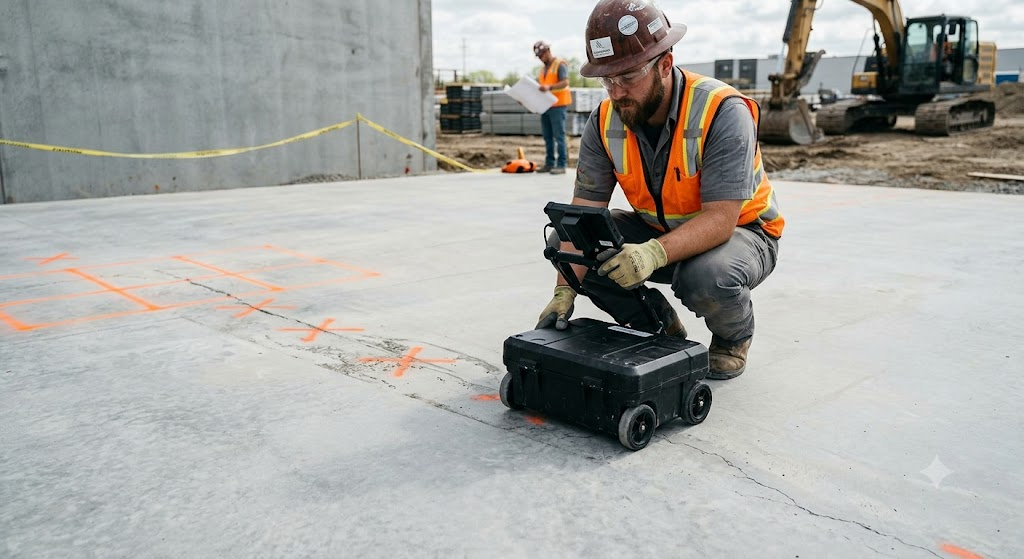

If your job involves managing properties, doing renovations, or running construction projects, cutting through concrete slabs is part of the process. And when you plan to cut, core, or anchor into a concrete slab, you first need to know what’s inside it. A concrete slab is a complex system that consists of rebar (steel reinforcement bars), post-tension cables, electrical conduits, plumbing sleeves, and sometimes just unexpected things buried inside. Drilling or saw cutting without knowing what’s underneath can lead to expensive damage and repair, project delays, and serious safety risks.
This guide will walk you through a few red flags that indicate you should do a subsurface scan. This is a simple decision guide to help you decide when to bring in GPR (Ground-Penetrating Radar) versus when a basic visual inspection is probably enough.
What Is the Need for Subsurface Scanning
Many things can go wrong in a concrete project, but the most catastrophic and expensive disasters can be avoided. Doing a subsurface scan (like with GPR) helps protect workers, keeps the project on time, and stops you from having to rip out and redo work later. Subsurface scanning also helps preserve the integrity of these concrete slabs and anything buried within them (rebar, post-tension cables, pipes, conduits, etc.). It also provides an official record that owners and contractors can use later if there’s ever a dispute or problem.
7 Red Flags to Indicate Your need Subsurface Scan
1. Drilling Near Unknown Utility Locations
If you’re about to cut or drill, or core into the slab and you don’t know exactly what’s underneath, this is a major red flag. Hitting a live water pipe, electrical conduit, or other buried system can cause safety hazards (flooding, electrocution, gas leaks, expensive repairs. Look at the original “as-built” drawings, talk to building maintenance staff, and if the drawings are missing, old, or incomplete, assume the slab is unknown and scan it. You should scan before any cut or core deeper than 1 inch, and definitely in risky spots like kitchens, mechanical rooms, or near expansion joints.
2. Project is near Post-Tensioned (PT) Slabs or Tendons
If you’re working near post-tensioned concrete (PT slabs), this is a high-risk situation. PT tendons are steel cables under high tension that give the slab its strength. Cutting one can cause sudden structural failure and a safety risk. Look for signs or records that say it’s PT concrete. These slabs usually have fewer joints, longer spans, and visible anchors at the edges. Always scan before doing any work on PT slabs. Combining GPR with input from a structural engineer is the normal safe practice.
3. Localized Deflection, Sagging, or New Cracks
If you notice the slab sagging, dipping, or developing new cracks in one area, treat it seriously. These signs usually mean there are voids, weak spots, or layers separating underneath. Cutting or adding load without checking can make the problem worse. Walk the area and listen for hollow sounds when tapping, measure cracks, and note any staining or water pooling. Scan immediately if you see a new or growing movement. Combine tap testing (sounding) with GPR to locate problems accurately.
4. Corrosion Staining, Efflorescence, or Spalling
Rust stains, white powdery deposits (efflorescence), or flaking/spalling concrete on the surface are warning signs. These signs usually mean the rebar inside is corroding, which weakens the slab over time. Look for rust stains, flaking, or old patches and take photos and note when previous repairs were done. Scan to see if corrosion is widespread or near important structural areas. GPR helps map rebar conditions and find hidden voids.
5. Installing Anchors or Fall-Protection Points
If you’re installing anchors, heavy machinery bases, or safety lifeline points, scan first. These create point loads, and putting them over a void or weak spot can cause failure. Map where the loads will go and check records. Always scan safety-critical anchors and any structural penetrations, especially in buildings that are still occupied.
6. Saw Cuts and Slab Penetration Near Expansion Joints
Be extra careful when cutting near joints. Expansion and construction joints may hide services or construction gaps. Cutting them blindly without knowing reinforcement layout can damage load-bearing elements. Map the joints and check their condition. Scan a 3-foot zone on both sides of any joint before cutting.
7. Renovation Work in Older Buildings
The 7th red flag applies when you’re doing renovation or cutting work in old buildings where the original plans are missing or unreliable.
Many older buildings don’t have accurate “as-built” drawings (the final plans that show what was installed during construction). You usually don’t know what materials were used, where the rebar, post-tension cables, conduits, or pipes are located, or what previous repairs were done.
Because of this lack of information, there’s a much higher chance of unexpected problems like hitting hidden utilities or encountering hazardous materials like asbestos that was commonly used in older repair mortars or floor toppings.
What Can You Do:
- Collect any drawings or records that still exist. Talk to building maintenance staff or long-time operators about past renovations.
- Physically walk the area and mark anything that looks unusual (patches, different floor levels, cracks, etc.).
When to Scan:
If the building records are missing or unreliable and you plan to cut, core, or drill deeper than just the surface layer, you should do a subsurface scan (GPR) before starting work.
Quick Onsite Checks You Can Run in Under 15 Minutes
A. Document Review
Look at the original “as-built” drawing and any maintenance records. Pay attention to anything that doesn't match or seems missing.
B. Visual Walk
Walk the entire area and take photos; mark any visible cracks, water stains, or patchy spots on the floor. Make a simple map of where the issues are.
C. Tap Test (Sounding)
Use a hammer or rubber mallet and tap the slab in a grid pattern (every 2–3 feet).
If you get a solid dull thud sound, it means the concrete is good. A hollow, high-pitched ringing sound indicates possible delamination (layers separating) or voids underneath.
D. Magnet Test
Use a strong hand magnet and drag it across the surface. It will stick or pull towards areas with shallow rebar. This is cheap and easy, but it only finds rebar close to the surface.
E. Probe Inspection
In safe, non-critical areas, you can drill a small ¼-inch pilot hole to check the depth of concrete cover over rebar. Only do this after making sure there are no post-tension cables or other high-risk items below.
F. Interview Site Staff
Talk to building maintenance staff or long-time employees. Ask them:
- Where previous repairs were done.
- How the slab was poured.
- Any areas that have always been problematic.
How to Read Signs
Here’s how to look at all the warning signs together and decide how urgently you need to get a subsurface scan done.
Immediate Risk: Call Scan Professionals Right Away
- You’re about to core or saw cut near suspected post-tension (PT) cables.
- You’re installing safety-critical anchors (lifelines, fall protection, etc.).
- You see serious structural problems like big sagging areas or cracks that are getting wider.
In these situations, stop work and call for a scan immediately. The risk is too high to proceed without knowing what's underneath.
High Priority: Get Scanned Within a Few Days
- You see rust stains and corrosion signs.
- You’re working in active construction zones where utility locations are unknown.
- You’re renovating old buildings with missing or unreliable documentation.
Moderate Priority: Scan Before the Final Works
- You’re doing non-structural cuts or holes (not affecting the building’s strength).
- You’re installing general equipment or doing retrofits.
- You still have time in the schedule to plan.
- In these cases, scanning is still important, but you have a bit more flexibility to schedule it before the final phase of work.
Determine whether to use GPR or Visual.
Visual Inspection
Apply when: There are no penetrations to be undertaken, surface wear only, routine maintenance checks.
Pros: Fast, cheap.
Cons: Skips items embedded in text.
Tap Testing/Sounding (ASTM D4580)
Apply when: Decks/overlays have hollow spots and/or are suspected of delamination.
Pros: Quick, portable.
Cons: Low resolution, subjective results.
Windsor Probe (ASTM C803)
When to use: The in-place compressive strength requirement is quickly estimated.
Pros: Non-destructive-ish, fast.
Cons: Needs to be correlated with cores, not an alternative to cores to validate.
GPR Scanning
Apply when: Seeking rebar, PT cables, conduits, voids, slab thickness changes, or cutting/coring is planned.
Cons: This is suitable for mapping embedded features across areas but not for PT detection – but this can be achieved if there is engineering as well.
Cons: The operator needs to be skillful, and the results need to be interpreted; not effective for very attenuating materials or wet ground.
Targeted Core Drilling
When to use: If the compressive strength is required to be laboratory tested, when performing petrographic testing, when needing to physically examine areas of the structure that contain a problem that was identified by non-destructive testing.
Consideration of rations must be supplied at one-day intervals. Considerations should be fed every day.
Cons: Destructive, requires prep, and should be as planned as possible to avoid conflicts once the sites have been scanned.
A Simple Flow of Decisions to Select a Test
- Will cutting, coring, and/or anchor installation be happening? If yes, go to 2. Otherwise, visual/sounding can be used.
- Do you require a PT slab or have to consider having a PT slab nearby? If the answer is yes → GPR + engineer consultation (do not core before scanning).
- Is the information reliable and up-to-date as-built drawings? If there is no GPR response in favor of the unknown areas, map them.
- If you're looking for a laboratory up to "strength" which is Avagard or higher, use an approved rock strength tester. If yes, then use GPR to find safe scoring spots, then cores for lab testing.
- Is the concern contained to a limited area (one small area) or area-wide? Local → GPR spot scan; Area-wide → grid GPR survey.
Figuring out the decision matrix for GPR vs inspecting visually vs other tests.
Conclusion
If you're working in Virginia, Maryland or Washington, DC, and planning to drill, core, install anchors, or do renovation work on slabs you’re unsure about, reach out to Concrete Insight LLC. We’ll review your drawings, discuss the site conditions, and recommend the right testing plan for you.
Call Concrete Insight LLC to discuss your project, get a precise quote, and confirm the right test plan for your job.
Frequently Asked Questions (FAQs)
Q1. How long will it take to perform a GPR survey?
A: Typically 1-3 hours for small scans (single room, one slab section). Longer for engineering-level reviews (area grids, scans) where time may be measured in days.
Q2. Can GPR detect everything under the concrete slab?
A: GPR is superb at detecting reinforcing steel, post-tensioning strands, conduits, cavities, and slab thickness variations, but it's not perfect. High attenuation material, wet environments, dense and heavily concentrated reinforcing, or multilayer materials will diminish its accuracy.
Q3. Is it safe to score after the GPR test?
A: Yes, once a competent GPR operator has mapped out all embedded materials and identified scoring points safely. When working with post-tensioned slabs, it's imperative to validate the results with the project engineer.
Q4. Are depth estimates produced by GPR surveys dependable?
A: Depth estimates generated are quite reliable and usually within tolerances, but depend on signal velocity calibration and proper material conditions.
Q5. Is there an option for an emergency GPR scan?
A: Yes, depending on availability of personnel, equipment, job location, and safety, many GPR companies can perform same-day GPR scans during emergencies.
Comments