
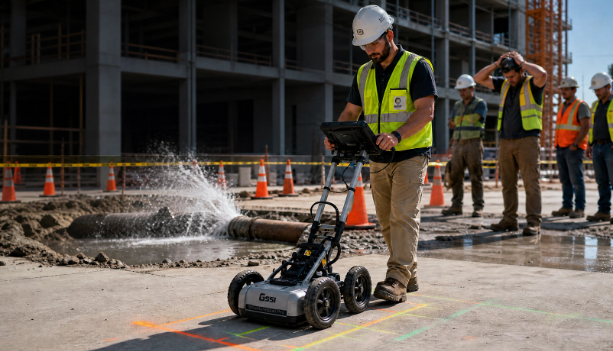

Concrete hides everything that matters.
Once a slab is poured, the surface becomes misleading. Clean finish. Straight lines. Predictable structure. But underneath, it is a different system entirely: steel reinforcement, tension cables, conduits, plumbing routes, repair patches, and sometimes undocumented changes that were never updated in drawings.
Most costly construction mistakes don’t come from complex engineering decisions. They come from one simple action taken without enough information: drilling or cutting into concrete without GPR Scanning.
That single gap in visibility is where budgets break.
Why Concrete Becomes a Risk Zone After It’s Built
Concrete is not static internally. Even after curing, it carries a dense and evolving internal layout shaped by design changes and field adjustments.
Inside a typical slab, you may find:
- Reinforcement steel in multiple layers
- Post-tension cables under high stress
- Electrical conduits added during last-minute routing changes
- Plumbing lines shifted during installation phases
- Voids from improper compaction
- Repairs from previous penetrations
None of this is visible from the surface. That is why GPR Scanning is used before any mechanical work begins.
Without GPR Scanning, teams rely on drawings that often represent intent, not reality.
How a Small Task Turns Into a Major Financial Event
A core drill or saw cut is often treated as routine work. Quick setup. Quick execution. Move on.
But the reality is different when GPR Scanning is not performed beforehand.
A single penetration can trigger:
- Striking post-tension cables (high-risk structural damage)
- Cutting electrical conduits (power shutdowns or safety hazards)
- Damaging plumbing lines (water intrusion and slab remediation)
- Hitting dense rebar clusters (structural integrity concerns)
What starts as a small operation turns into a multi-trade emergency.
This is the point where GPR Scanning becomes the difference between controlled work and uncontrolled damage.
The True Anatomy of the $25,000 Cost
The “$25,000 mistake” is not one bill. It is a chain of smaller costs triggered by one avoidable incident.
When GPR Scanning is skipped, the financial breakdown typically looks like this:
1. Immediate emergency response
- Electrical isolation and repair: $2,000 to $10,000
- Emergency structural assessment: $1,500 to $5,000
- Specialty contractor mobilization: $1,500 to $5,000
2. Physical repair and reconstruction
- Concrete removal and reinstatement: $3,000 to $12,000
- Reinforcement repair or rerouting: $2,000 to $8,000
- Utility rerouting and replacement: $1,000 to $6,000
3. Project downtime losses
- Idle labor crews: $2,000 to $15,000 per day
- Equipment rental delays: $500 to $3,000 per day
- Schedule compression penalties: $5,000 to $20,000 depending on contract terms
4. Secondary and hidden costs
- Inspection delays
- Coordination rescheduling across trades
- Re-mobilization of subcontractors
- Client communication and disruption handling
One incident easily crosses $25,000 once these layers stack together.
This is exactly the type of scenario GPR Scanning is designed to prevent.
What GPR Scanning Actually Does on Site
GPR Scanning uses high-frequency electromagnetic waves to “read” inside concrete without damaging it. The radar signals reflect differently depending on what material they encounter.
A trained technician interprets those reflections to map internal conditions.
With proper GPR Scanning, teams can identify:
- Rebar spacing and depth variations
- Post-tension cable paths and anchor points
- Electrical and data conduits
- Plumbing routes and embedded piping
- Structural inconsistencies or voids
- Previously patched or altered zones
Instead of assumptions, GPR Scanning delivers a visual representation of internal slab conditions before work begins.
Where Projects Are Most Exposed Without GPR Scanning
Certain activities carry higher risk because they directly interact with hidden systems:
- Core drilling for HVAC penetrations
- Anchor installation for structural steel or equipment
- Saw cutting for slab openings or trenching
- Renovation in older or modified buildings
- Utility upgrades in mixed-use or commercial facilities
- Tenant improvement work with unknown slab history
In all these cases, GPR Scanning is not optional in practical terms—it is risk control.
Why Drawings Fail in Real Construction Conditions
Even accurate drawings lose reliability over time.
Common issues include:
- Field changes during construction not documented
- Utility rerouting after initial installation
- Multiple renovation phases across years or decades
- Missing or incomplete as-built documentation
- Overlapping systems installed by different contractors
In older buildings, drawings often represent the original design only—not the current condition.
This is where GPR Scanning fills the gap between documentation and reality.
Cost Perspective: Prevention vs Damage
The financial comparison is straightforward:
- GPR Scanning per job: $300 to $2,500 (typical range)
- One concrete strike incident: $5,000 to $25,000+
- Severe structural or utility damage: $25,000 to $100,000+
Even at the highest scanning cost, GPR Scanning remains significantly lower than one incident.
The difference is not marginal; it is exponential.
Additional Value Beyond Cost Savings
While cost prevention is the most visible benefit, GPR Scanning also supports:
I. Safety improvement
Reduces risk of striking live electrical systems or tension cables.
II. Schedule stability
Prevents unexpected stoppages that delay multiple trades.
III. Better project planning
Allows accurate positioning of penetrations and anchors.
IV. Reduced rework
Eliminates the need for corrective demolition or patching.
V. Insurance and compliance support
Provides documentation of due diligence before invasive work.
Each of these adds long-term value beyond immediate cost avoidance.
Why Experience Alone Cannot Replace GPR Scanning
Experienced contractors develop strong instincts, but instincts do not see inside concrete.
Even skilled teams face uncertainty due to:
- Hidden post-tension systems
- Unrecorded field modifications
- Outdated construction documentation
- Dense reinforcement variations
- Unknown slab history in renovated spaces
Experience reduces risk. GPR Scanning removes uncertainty.
Concrete Insight LLC: GPR Scanning in the DMV Area
Concrete Insight LLC provides professional GPR Scanning services across the DMV region, supporting contractors, engineers, and construction teams who require accurate subsurface information before any drilling, coring, or cutting begins.
Our GPR Scanning process focuses on precision interpretation and clear field marking so teams understand exactly what exists inside concrete before work starts.
We handle projects ranging from small residential slabs to large-scale commercial and infrastructure developments. Every GPR Scanning service is designed to reduce risk, prevent costly mistakes, and support safe execution on site.
When subsurface uncertainty threatens project timelines or budgets, our GPR Scanning service becomes the decision point that prevents escalation.
Final Perspective
The gap between a few hundred dollars and $25,000 is not a budgeting issue. It is a visibility issue.
Concrete does not reveal its internal structure without help. That help comes from GPR Scanning.
Every project that skips it carries hidden exposure. Every project that uses it removes one of the most expensive risks in construction.
Work With Concrete Insight LLC
If your project involves drilling, cutting, coring, or modifying concrete, GPR Scanning should be part of the process before work begins.
Concrete Insight LLC provides reliable GPR Scanning across the DMV area to help you prevent avoidable damage, control project costs, and maintain schedule certainty.
Contact us today to schedule GPR Scanning and protect your project from expensive, preventable mistakes.
Comments